
New Bedford Resident Lookup Sources and Roles
Choose a source by the question it can actually answer. The city assessor can identify a recorded property owner, while a deed identifies parties to a recorded instrument. Neither label alone establishes an occupant. Court, vital, library, and election sources have their own access rules, which is why a reliable resident lookup records the role shown instead of flattening every result into “resident.”
| Record | What It Confirms | Where | Access |
|---|---|---|---|
| Assessor parcel card | Owner of record, parcel, situs, possible mailing address, assessment context | New Bedford AxisGIS | Public map/card; city counter or request can address older material |
| Recorded deeds | Grantor, grantee, legal transfer, recording date, instrument reference | Bristol South Registry of Deeds | Public index; images and certified copies may require purchase or a counter route |
| Individual voter status or local list | Individual registration status, or the public fields available in a municipal list | Massachusetts Voter Registration Search and New Bedford election officials | Individual form requires identifying fields; local-list requests remain limited |
| Public court index | Indexed party role, case number, case type, dates, and docket context | MassCourts eAccess and local clerks | Public index varies; some documents require a clerk or courthouse terminal |
| Vital record | Identity, family, event date, and place when access rules permit | New Bedford City Clerk, Massachusetts RVRS, or State Archives | Certified copies and historical access follow record-specific rules |
| City directories | Historical address, occupation, spouse/status clues, and street-section entries | New Bedford Free Public Library, State Library, and digitized collections | Historical snapshot; inspect the original page rather than OCR alone |
| Obituary index | Newspaper date/page clues and family or community context | New Bedford Free Public Library Standard-Times index | Index runs from 1968 to the present; staff can locate fuller material |
| Probate file | Estate, fiduciary, heir, and property-disposition clues | Bristol Probate and Family Court | File access depends on the case and any restriction |
| SOS or license record | Business filing, officer, agent, credential, or board status | Secretary of the Commonwealth and state license search | Public filing or license evidence, not a residential identity |
Start with an address-linked record if the question concerns a parcel, an individual voter-status response if the person can supply the required details, or a historical directory and obituary trail for an earlier association. Keep “owner,” “mailing contact,” “party,” “registrant,” and “historical occupant” as separate labels throughout the work.
Verify New Bedford Resident Records
New Bedford records span Portuguese, Cape Verdean, Irish, maritime, and other community histories, so a name string is only a starting clue. Normalization can include accents, hyphenation, married or maiden names, middle initials, suffixes, and compound-name spacing. The Registry’s own guidance specifically calls for trying De Mello and DeMello, La Cruz and Cruz, and Dos Santos and DosSantos.
Before treating two results as one person, compare at least two independent attributes. Useful pairings include an address with a date, a parcel with a spouse or parent clue, an occupation with a directory year, or a court jurisdiction with a recorded instrument. A full birth date, phone number, email address, or sensitive case detail is not needed to make that comparison and should not be copied into notes.
Record the role first. A deed grantor, a parcel owner, a voter registrant, a court party, and a historical directory entry describe different relationships and may not describe the same period.
New Bedford Record Roles
AxisGIS searches by owner name, street address, or parcel ID and can lead from a highlighted parcel to a CAI Property Card. The card is assessment evidence. Its selected parcel shape, situs address, owner name, map or lot identifiers, sale and tax context, and possible mailing address belong in a source note with the date viewed.
New Bedford’s planning materials make the distinction explicit by separating the subject map number, lot, and address from owner name and mailing address. A situs is the parcel’s physical location; a mailing address is where assessment correspondence may go. An estate, trust, bank, or out-of-area owner can appear on an assessment record without being an occupant.
For the legal chain, search the owner as a grantee in the Southern Bristol Registry, then inspect the instrument’s recording date, book/page or document number, and legal description. The five-town Southern District also includes Acushnet, Dartmouth, Fairhaven, and Westport, so the jurisdiction in a result deserves its own note. The Registry’s web encumbrance list is not the official record, and older index books can be the necessary next step.
New Bedford Court Lookup
MassCourts eAccess begins after its public-records entry step. Select Court Department first, then use the department-filtered division and location controls. The available tabs are Name, Case Type, Case Number, and Ticket/Citation Number. This is an index of public case context, not a general identity directory.
The Name tab is a civil search: enter a last name with at least two characters and initial capitals, then try only necessary variants. A Case Number must match exact capitalization, spaces, and leading zeros. The Case Type tab uses a begin and end date with a maximum 30-day range, so a narrow case family and date window are more useful than a broad sweep.
Results can place a person in a public filing without proving where they live. Use the result’s department, division, location, and role to decide whether the relevant New Bedford clerk is the next custodian. Some material remains available only through the clerk, register, recorder, or courthouse public terminal; juvenile, sealed, impounded, adoption, and protected material is excluded from public name searching.
The result inventory to preserve is:
- party name and role;
- case number and case type;
- court department, division, and location;
- filing date, date range, events, docket entries, and disposition;
- document links where available; and
- any visible restriction or clerk/terminal requirement.
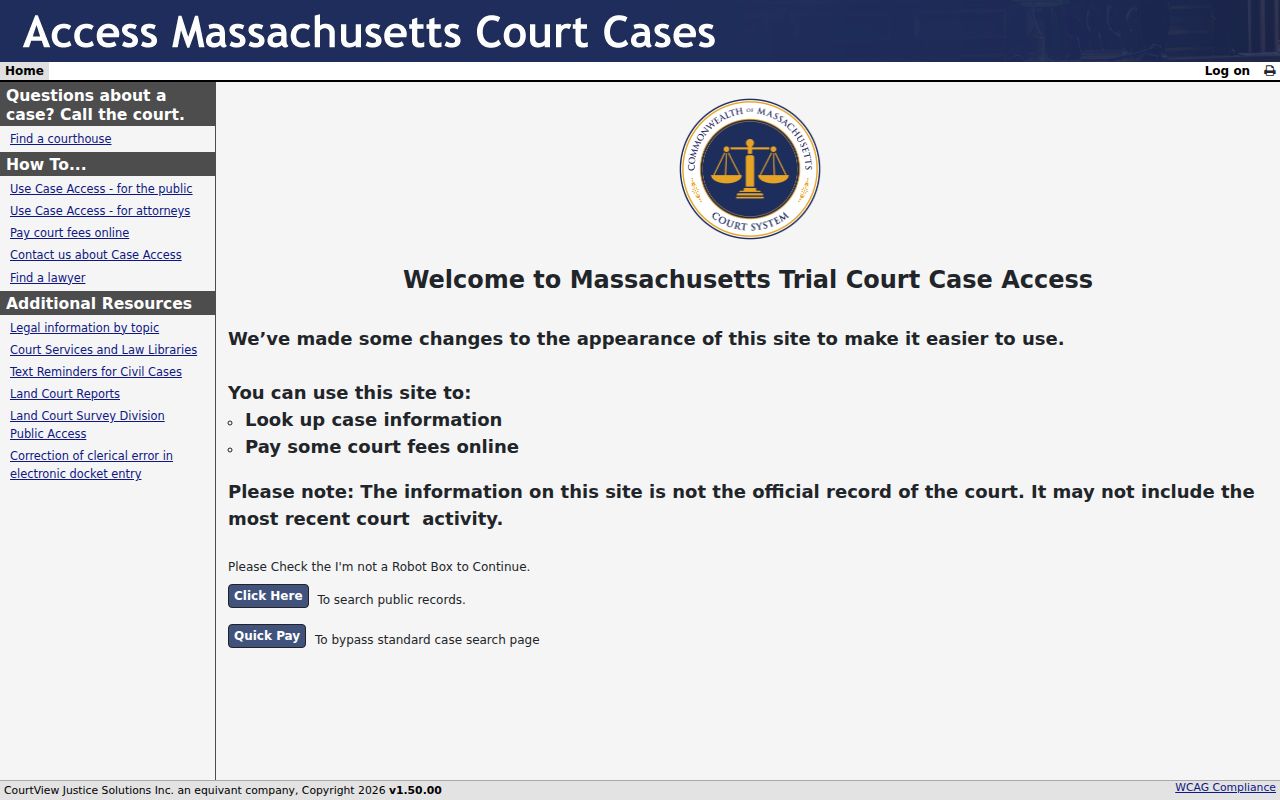
MassCourts eAccess presents the public court-search entry point before a user selects a department, location, and search tab.
New Bedford Voter Check Limits
The Secretary of the Commonwealth’s individual voter-status form requires first name, last name, date of birth by month, day, and year, the residential ZIP code, and an agreement checkbox. The state notes that a recent registration may take two or three weeks to appear and suggests trying a prior ZIP after a move. A no-match is not a finding that someone does not live in New Bedford.
A local voter list is a different channel. Massachusetts describes public local-list fields such as name, address, party, date of birth, active or inactive status, and certain election-history or registration fields, while excluding phone, email, veteran status, permanent-absentee data, confidential records, and minor pre-registrant information. A targeted request to the City Election Commission should identify the list date, fields, and desired format.
The statewide central registry is not a general public download under G.L. c.51, §47C. That boundary matters even where a municipal list may be available under election law and the Public Records Law. Keep any returned entry labeled as a registration record and do not treat it as a household inventory.
The official voter-status form is designed for an individual search with the required identifying fields.
Verify New Bedford Residents
A short, ordered record trail is easier to correct than an accumulated collection of possible matches. The following sequence keeps each source in its proper role and helps prevent an old directory, a deed party, or a mailing contact from becoming an unsupported current-residency claim.
- Write the name variants and the question being tested, such as a historical association, an estate connection, or a parcel owner.
- Anchor the inquiry in one record that supplies a role and date, such as an AxisGIS parcel card or a historical directory page.
- Compare two independent attributes in a second source, retaining the exact record identifier, source URL, and access date.
- Use the Registry, MassCourts, voter-status form, or library trail only for the question each one can answer.
- For a needed certified or fuller record, contact the actual custodian with the case number, document number, book/page, or vital-record details.
- Docket
- A court’s running record of a case, its events, filings, and disposition information where public.
- Index versus image
- An index helps locate a record; an image is the underlying instrument or document and can have separate access, purchase, or terminal rules.
- Certified copy
- A custodian-issued copy authenticated for the purpose the custodian permits, rather than an informal search result or screen view.
New Bedford Vital Record Routes
For a local event, the New Bedford City Clerk’s Vital Records Department is in Room 118 at City Hall, 133 William St. The local ordering route covers 1787 to the present, but it is a certified-copy service rather than an open name database. The current Permitium page lists Birth, Marriage, and Death choices and a $20 local copy fee plus a nonrefundable $5 online service/card fee; mail and counter routes remain available.
Massachusetts RVRS supplies statewide records for 1936 to the present, while the Massachusetts Archives handles 1841 to 1935 certificates and indexes. A birth or marriage record can have eligibility limits under G.L. c.46, including restrictions for certain records. The historical-access exception generally applies after 90 years for birth and marriage records and 50 years for death records, subject to statutory limits and protection of sensitive fields.
Use the City Clerk for a New Bedford local copy, RVRS for the statewide era, and Archives for the earlier period. A divorce is a Probate and Family Court record, not a City Clerk divorce certificate. The City Clerk can direct a vital amendment or correction request; do not attempt to resolve a discrepancy by changing notes from another custodian.
New Bedford Family Record Trails
A carefully bounded heir trail can connect the library’s Standard-Times obituary index, a Probate and Family Court file, and an estate conveyance recorded in the Registry. The obituary index begins in 1968 and gives newspaper date and page clues; the library can use digitized or microfilmed holdings to locate fuller material. A specific date makes its reference service more actionable.
For an earlier person, the 1836 to 1971 city-directory runs, street sections, census material, and library special collections can show an historical address or community connection. A city directory is a snapshot near its publication date, not a statement of current residence. The New Bedford Directory Book explains how to read those year-specific entries alongside the original scans.
Probate can identify an estate, fiduciary, or property-disposition clue, while a deed can identify a recorded transfer. Neither record should be used to infer unlisted relatives or a private current location. Preserve the role and date that the source actually supplies.
New Bedford Custodian Requests
When an index does not expose the needed record, the fallback is a narrow request to the custodian, not a request that an office build a new personal profile. Massachusetts Public Records Law, G.L. c.66, §10 permits electronic, mailed, in-person, and verbal requests, although a written request is preferable. Identify the record type, date range, person or address variant, and preferred existing format.
The City Clerk, Assessor, Election Commission, Registry, court clerk, library, RVRS, and Archives each hold different material. The law’s general response framework does not erase exemptions, redactions, vital eligibility rules, election restrictions, or court impoundment. A request may need clarification, and a custodian need not create a new list or answer a research question by compiling one.
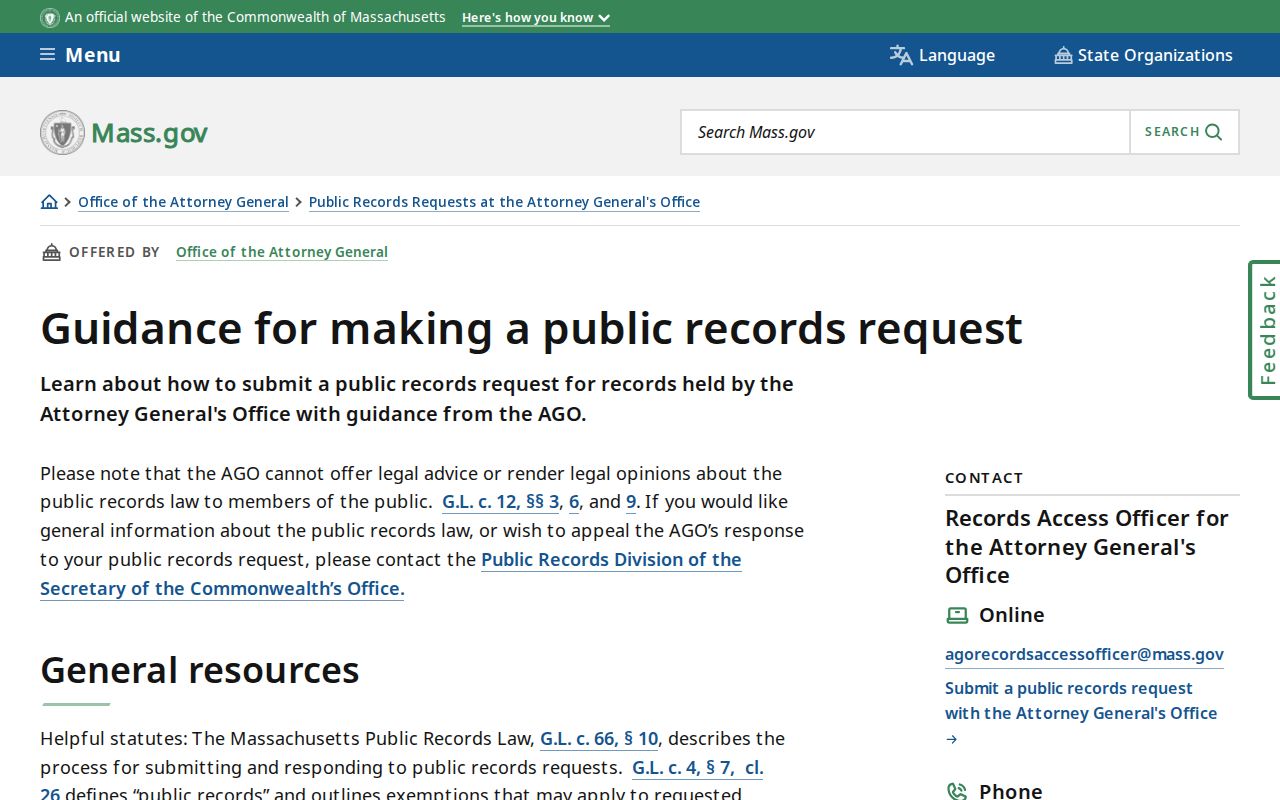
The Commonwealth’s public-records request guidance explains the general request process before a New Bedford resident lookup question is sent to a specific custodian.
Use a record type and date range that the custodian can identify. A request route does not convert protected data into public information.
For a correction, cite the exact field and identifier. An assessor owner/address correction, an election-office registration correction, a City Clerk vital amendment, a Registry recording correction, and a court docket or document correction follow different routes. This record-specific approach gives the custodian a clear place to begin.
New Bedford Lookup Limits
Some records are public in limited forms, while ACP substitute addresses, confidential voters, protected vital details, motor-vehicle personal information, sealed or impounded court material, and restricted adoption material are not open resident sources. Massachusetts Safe at Home, the Address Confidentiality Program, provides qualifying participants with a substitute address and mail forwarding. G.L. c.51, §47C separately restricts the statewide voter registry.
Do not try to reconstruct a protected address by combining parcel, family, court, or historical sources. Keep source copies to the minimum needed, avoid contacting someone at a sensitive address, and return an apparent error to the agency that maintains the record. A commercial profile removal request is not a replacement for an ACP application, statutory impoundment, or custodian correction.
Lawful use. Personal and family research, estate work, reconnecting with a friend, and checking a source are lawful purposes. Stalking and criminal harassment are addressed by G.L. c.265, §§43 and 43A; do not use a record trail to watch, intimidate, or expose another person.