
New Bedford City Directory Holdings
Start with the Massachusetts State Library holdings list for any New Bedford city directory search. The run is substantial but uneven. No list promises that every year survives or that every printed name is legible. Each access point serves a different purpose. A scan supports first-pass browsing from home. A reference request or holdings list, in turn, can pin down a missing edition. It can also tell you which library keeps it. The local library, Internet Archive, FamilySearch, and the State Library all play distinct roles. That workflow depends on each of them.
| Collection | Years | Where Held | Access |
|---|---|---|---|
| State Library New Bedford directory run | 1836; 1838–39; 1841; 1845; 1849; 1852; 1856; 1859; 1865; 1867–68; 1869–1885; 1887; 1889; 1890–1919; 1921; 1923–28; 1930–32; 1934; 1936–37; 1939–41; 1943; 1947; 1949; 1952; 1955; 1961–62; 1965–66; 1969; 1971 | Massachusetts State Library | Holdings list and collection request |
| Early New Bedford directories | 1836–1867, with listed gaps | State Library, Internet Archive, FamilySearch catalog | Browse scans where available; inspect page images |
| Greenough directory volumes | 1869–1919, with listed gaps | State Library and digitized collections | Holding or scan depends on edition |
| Later directory volumes | 1921–1971, with listed gaps | State Library and New Bedford library holdings | Selected scans and reference access |
| Voting, suburban, and vicinity volumes | 1884; 1917–1969 selected runs; 1973 Blue Book | State Library and local reference collections | Supplementary, not complete resident rolls |
The same State Library list names New Bedford voting lists for 1884, 1924, 1939, 1940–56, 1959, 1966, and 1980, suburban directories for selected years between 1917 and 1969, and a 1973 New Bedford and vicinity PSP Blue Book. These companion volumes can bridge a narrow gap. Each, though, gathers people by a different rule of inclusion.
New Bedford City Directory Begins in 1836
The 1836 edition anchors the New Bedford directory sequence. FamilySearch's catalog describes The New Bedford directory as a 222-page Crapo volume. Its digital provenance runs through the New Bedford Public Library and the Claire T. Carney Library at UMass Dartmouth, with Internet Archive access. The book is more than an alphabetical name list. Its catalog context ties it to New Bedford, Fairhaven, whaling, and civic material, so the advertisements, institutional pages, street material, and special lists may answer a question the name section cannot.
The Internet Archive scan of the 1836 directory lets you inspect the edition yourself before asking a library to copy a page.
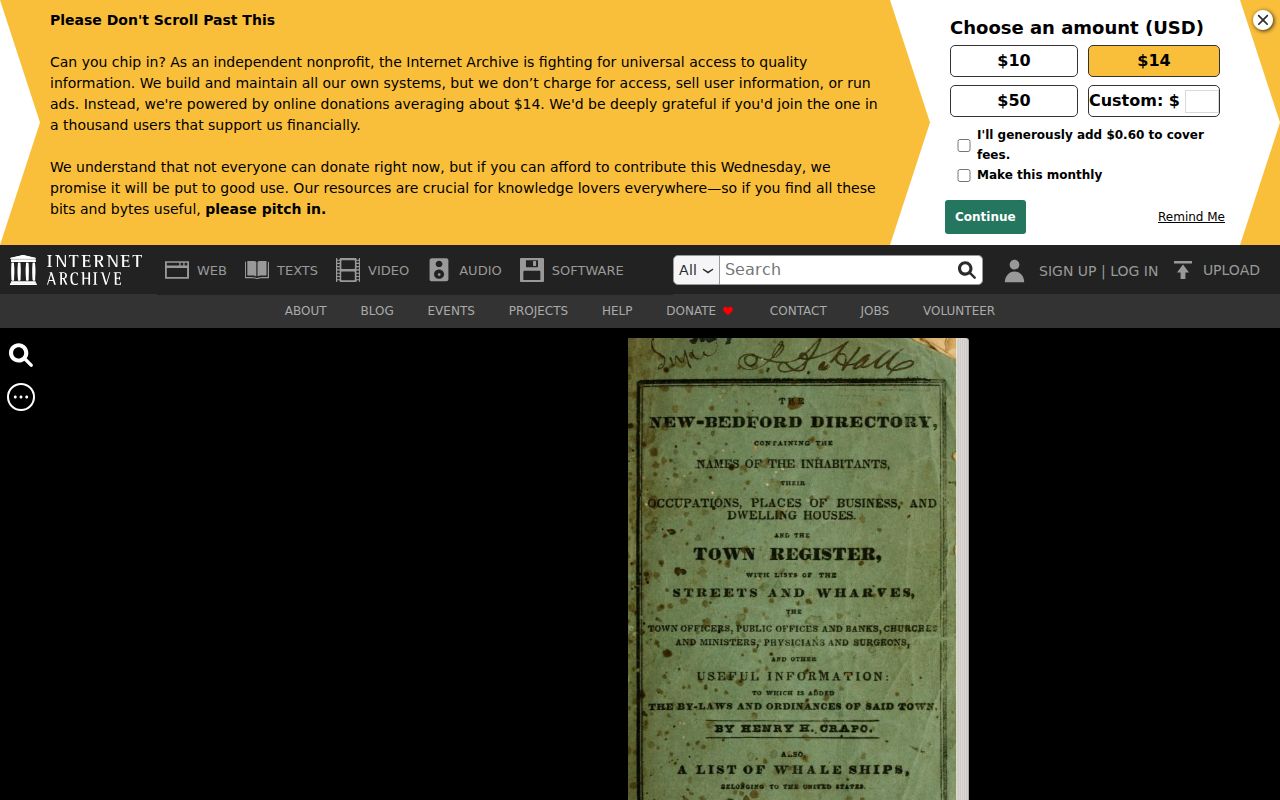
Read the image page and the printed page together. Scan pagination and printed pagination can differ. OCR also misreads names and street numbers, so the page image controls whenever a transcription matters.
New Bedford City Directory Publisher Eras
Publisher details help you pick the right volume and decode its abbreviations. Early titles appeared under the general New Bedford directory name. Catalog history credits H. H. Crapo, with printing by J. C. Parmenter, in the early volumes. C. Taber handled much of the 1850s. A. Taber & Brother printed the 1865 edition, and Dudley & Greenough followed in 1867. These marks matter most when a scan has an abbreviated title page or a catalog files a volume under the publisher rather than the city title.
W. A. Greenough Jr. enters in 1869, followed by Greenough Jones & Co. in 1871–73 and later Greenough company forms. Greenough remains the recurring publisher across the long 1883–1919 stretch. From volume 65 in 1937 onward, H. A. Manning appears as compiler or publisher. The publisher handoff still does not settle the edition question for you. The documented run has gaps, so confirm the actual year of any volume you use.
Note: Preserve the printed title-page publisher with the year when comparing shorthand marks or an unusual street spelling across editions.
New Bedford City Directory Scans and Shelves
The New Bedford Free Public Library Internet Archive collection is the direct landing point for digitized New Bedford directory volumes. A scan is only one channel, though. The New Bedford Free Public Library at 613 Pleasant Street offers local-history reference help. It also holds special collections, local newspaper resources, and on-site Ancestry Library Edition. Listed hours run Monday through Thursday, 9 to 9. Friday and Saturday hours run 9 to 5. Confirm them before you travel.
The State Library listing for New Bedford Free Public Library gives the library's reference contact. It also shows the catalog and branches at a glance.
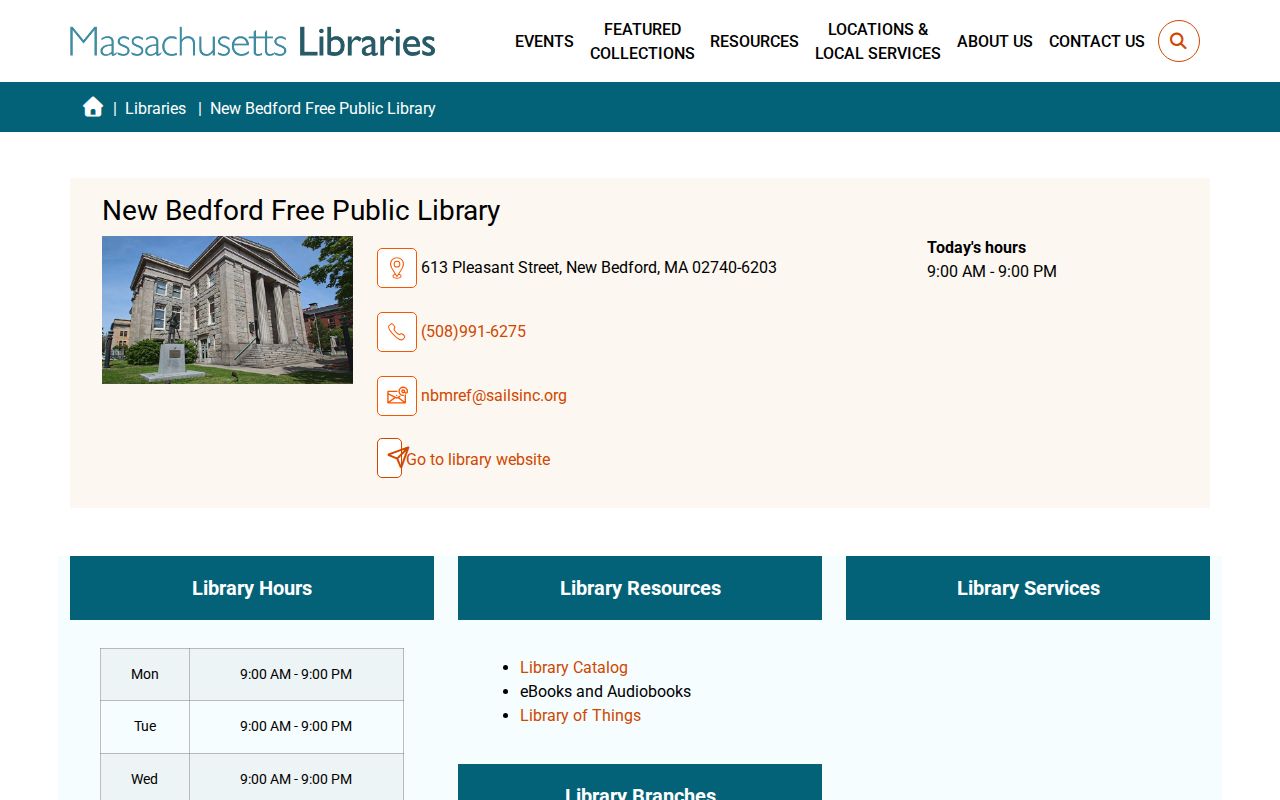
When a volume is not online, request a narrow search by surname, year, street, and the page image you want. A precise question gives staff something reproducible to work from. It also keeps you from mistaking a library catalog for a complete name index.
Decoding a New Bedford City Directory Entry
Transcribe the whole entry before drawing any conclusion. A common surname gains real value when paired with an occupation, residence, household cue, or business listing. The 1836 edition supplies no safe person-specific line to quote here. No sample name or address should be invented. Record the fields the volume actually prints. Preserve the exact key that edition uses for its abbreviations.
| Headword | Surname plus given name or initials; check adjacent entries for alternate spellings. |
|---|---|
| Trade, employer, or business | Occupation, status, shop, office, or maritime affiliation that can separate same-name people. |
| Residence | Street and number when printed, or an older street-only locator. |
| Household cue | Spouse, widow or widower notation, or another relationship note when the volume gives one. |
| Owner or renter mark | Read the edition’s abbreviation key. A repeated letter should not be assigned a meaning from another publisher. |
| Street and special lists | Street section, businesses, institutions, ships, organizations, and civic lists can corroborate context. |
| Volume and page | Edition year, scan page, and printed page, kept together for a later check. |
New Bedford families appear under accents, compound surnames, prefixes, initials, married names, and anglicized spellings. The city's Portuguese, Cape Verdean, Wampanoag, African American, Irish, and maritime histories make the page image essential. OCR often splits a prefix or drops a diacritic without any sign.
New Bedford City Directory Street Sections
The street section works the New Bedford city directory in reverse. Find the street and number first. Transcribe every listed name at that address. Then return to the alphabetical section for occupation, spouse or status, and any second address. Compare the neighboring street entries and the edition year. A wharf, school, church, mill, business, or multi-unit address may name a contact or institution. It may not list every person tied to the location.
- Criss-cross directory
- A reverse directory arrangement that runs by street and address, allowing an address-to-name search before the alphabetic section.
- Householder index
- An index organized around heads of households or an equivalent household listing, when a volume includes one.
- Abbreviation key
- The edition-specific explanation for marks and shorthand. Photograph or transcribe it before interpreting an owner, renter, widow, or business mark.
Keep the historical shelf apart from current assessment evidence when a parcel question comes up. Once an old street finding has a name attached, present-day address work belongs elsewhere. The New Bedford Street Directory takes over that route, following current addresses and parcel records rather than the aged volumes.
Tracing New Bedford City Directory Households
Treat every directory entry as a dated observation. That habit makes a household trail far stronger. Pair the directory year closest to a census with its address, occupation, and age clues. Then pull the next available directory to test whether the household moved, shrank, split, or lost someone to death or marriage. Federal census schedules are public through 1950 under the 72-year release rule. Massachusetts state censuses from 1855 and 1865 add two local snapshots between the federal counts.
- Start with the first known New Bedford city directory appearance and transcribe the page, occupation, and address.
- Follow the surname through later available editions, recording every spelling and address change rather than filling undocumented years.
- Use the street or criss-cross section to compare the address, nearby listings, and any institutional or business context.
- Match the closest 1855 or 1865 Massachusetts census and the relevant federal census from 1790 through 1950.
- Use a newspaper notice, deed date, probate file, permit, or obituary to test why a name appeared, moved, or disappeared.
A disappearance in the pages can mean many things. The person may have died, moved, joined another household, or been omitted entirely. A spelling change hides plenty of people too. So treat a missing name as a prompt for the next dated record, never as a conclusion.
New Bedford City Directory Obituary Bridge
Later directory editions pair well with the New Bedford Free Public Library's digital Standard-Times obituary index, which covers 1968 to the present. The library describes the index as updated daily. Each entry gives a surname, newspaper date, and page number. Those clues lead staff to digitized or microfilmed newspaper holdings. Check the original notice before trusting a relationship, address, or spelling.
The library Reference Policy sets the terms. A free 30-minute quick search covers special collections, area history, and obituaries. Full-obituary copy requests need a specific date. Newspaper work for 1829–1968 runs an estimated 5–7 business days, and 1969 to the present runs 3–5 business days. Each person gets three free obituary requests per year. After that, copies cost $5 each.
Note: Record the directory address and the obituary date separately, since a death notice may describe a later residence than the directory edition.
New Bedford City Directory Maritime Clues
A New Bedford residents directory entry is a starting point, not a finished story. The old city directories sometimes hold whale-ship material and an 1865 roster of citizens serving in the Army or Navy. That roster can point a researcher toward richer holdings elsewhere. The New Bedford Whaling Museum eMuseum is one of those destinations. Its collections bring together logbooks, photographs, manuscripts, rare books, and records tied to local industry. Many descriptions remain provisional, though. Treat anything found there as a lead. Confirm details against the original item and its dated record before relying on them.
The New Bedford Historical Society works from the Nathan and Polly Johnson House. It preserves and interprets the contributions of people of color across the region. Visits run by appointment. Office hours are Monday, Wednesday, and Friday from 10 to 4.
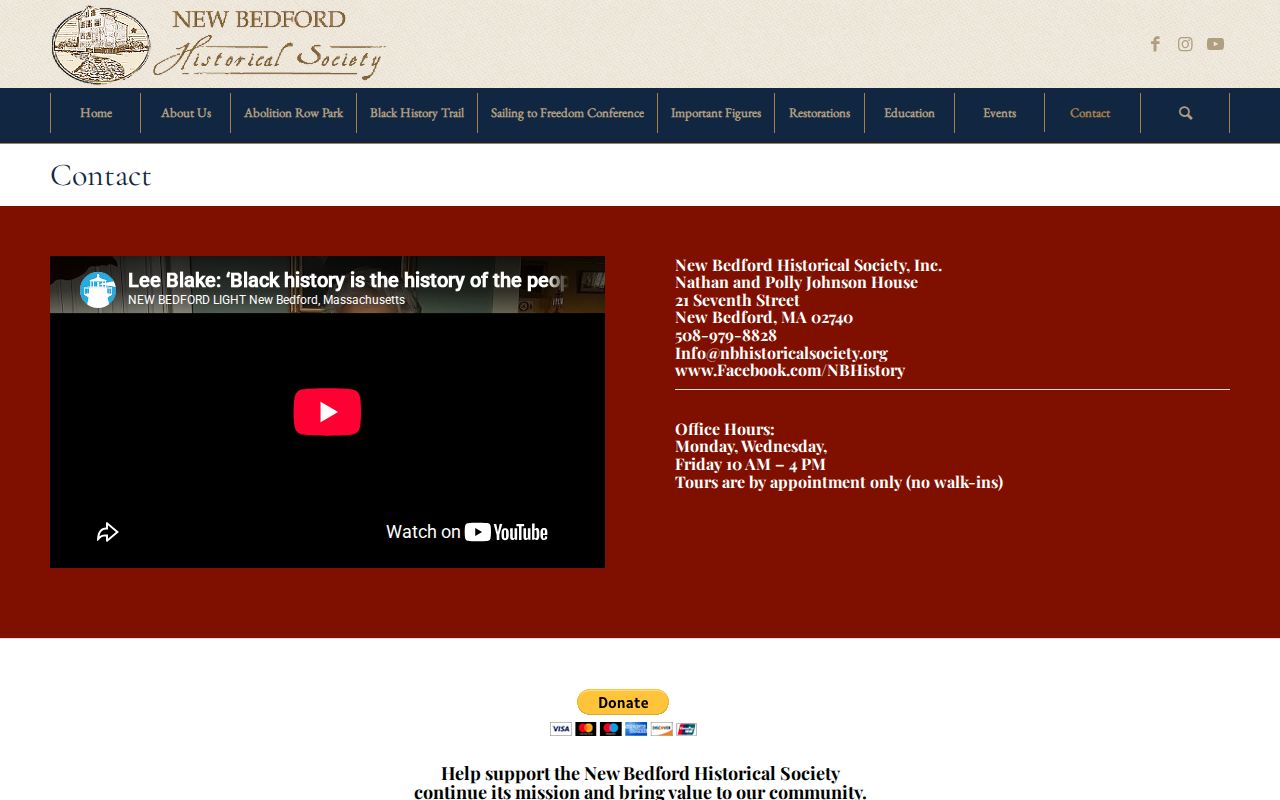
These collections supply historical setting for a name plucked from a directory: a maritime tie, a neighborhood, a family line, an institution. None of it replaces the printed directory page itself.
New Bedford City Directory Timeline
The directory record for New Bedford holds its value because every change is visible. The verified local sequence begins with the 1836 volume. Early Crapo, Parmenter, Taber, and Dudley & Greenough editions come before the long Greenough era, which runs from 1869 through 1919. Manning enters the line in 1937. State Library holdings continue, with gaps, through 1971. Alongside that, the City Clerk's preservation materials describe records reaching back to the late 1700s and microfilming work built to industry standards.
- 1836: the verified first New Bedford directory volume in the State Library sequence.
- 1869–1919: the long Greenough publisher era documented by catalog history and holdings.
- 1937: H. A. Manning appears in later volumes from volume 65 onward.
- 1971: the final year listed in the documented State Library New Bedford directory run.
That timeline explains why access varies so much. Some records survive only as bound volumes or scanned index pages, while directory and obituary discovery can happen online. When a search stops at an image gap, turn to the State Library list, the New Bedford library reference service, the State Archives, or the relevant custodian rather than assuming the historical record never existed.